Cryptocurrency theft is not just a consumer problem; it is an enterprise crisis. With billions in digital assets lost to hacks and fraud annually, businesses holding crypto on their balance sheets cannot afford to rely on basic security measures.
At the core of this security architecture lies the hardware wallet. Often misunderstood as a simple USB stick for storing Bitcoin, enterprise-grade hardware wallets are sophisticated security devices designed to isolate private keys from vulnerable, internet-connected environments.
This guide moves beyond the retail hype to explain exactly what a hardware wallet is, how it functions at a technical level, and why it is the cornerstone of secure B2B crypto operations.
What Is a Crypto Hardware Wallet?
A common misconception among newcomers to the space is that a crypto wallet actually “stores” the cryptocurrency itself, much like a leather wallet holds cash. In reality, your digital assets live on the blockchain. The wallet simply protects the access to those assets.
A hardware wallet is a dedicated physical device designed to generate and store private keys offline.
These keys are the cryptographic signatures required to authorize transactions. If a malicious actor gains access to your private keys, they have total control over your funds.
To mitigate this risk, the most robust defense is taking the keys offline. The premise is simple: if a wallet is disconnected from the internet, it becomes exponentially harder to hack. This isolation creates a nearly impenetrable barrier against remote attacks and forms the foundation of “cold storage.”
However, it is important to distinguish between a general “cold wallet” and a hardware wallet. While a cold wallet can be any offline storage method (even a piece of paper), a hardware wallet is a specialized device. Unlike “hot wallets” (software applications connected to the internet), hardware wallets keep critical keys within a secure environment—often a dedicated chip called a Secure Element—that never touches the internet.
For businesses, this distinction is critical. Using a dedicated hardware device ensures that even if a company computer is infected with malware or a network is compromised, the private keys required to move corporate funds remain isolated and unreachable.
Hardware Wallet vs. Cold Wallet: Understanding the Nuance
To truly grasp enterprise security, we must refine our terminology. A common misconception in the crypto space is using “cold wallet” and “hardware wallet” as interchangeable synonyms. While closely related, they are not identical.
All hardware wallets are cold wallets, but not all cold wallets are hardware wallets.
A cold wallet refers to the broader category of storing cryptocurrency offline. This is an umbrella term for any method that keeps private keys disconnected from the internet. This could be as primitive as writing a private key on a piece of paper (a “paper wallet”) or storing it on a dedicated laptop that has had its Wi-Fi card removed. While these methods are technically “cold,” they often lack the operational functionality required for business agility.
A hardware wallet is a specialized electronic device designed specifically for this purpose. It is a subset of cold storage that combines the security of offline isolation with the ability to interact with the blockchain safely. Unlike a paper wallet, which must often be “swept” (imported) into a hot wallet to spend funds—temporarily exposing keys to the internet—a hardware wallet allows you to sign transactions inside the device itself. The private keys never leave the secure element, even during a transfer.
Comparing Storage Methods
For enterprises, the distinction often comes down to usability and risk management during transaction signing.
| Feature | Generic Cold Wallet (e.g., Paper Wallet, Offline PC) | Hardware Wallet (Enterprise Device) |
| Primary State | Offline | Offline |
| Transaction Signing | High Risk: Often requires typing keys into a software wallet to send funds, exposing them to online threats. | Secure: Signing happens internally on the device chip; keys are never exposed to the computer or internet. |
| Ease of Use | Low: Cumbersome to set up and difficult to use for frequent transfers. | High: Designed for regular interaction while maintaining zero-trust security. |
| Human Error Risk | High: Vulnerable to typos, physical loss of paper, or improper disposal. | Low: often protected by PINs and backup phrases; device handles cryptographic complexity. |
| Ideal Use Case | Deep archival storage (years without touching). | Active treasury management, institutional custody, and secure B2B payments. |
For a business, relying on primitive cold storage like paper wallets is inefficient and risky during transfer events. A hardware wallet bridges the gap, offering the “cold” security of an offline vault with the “active” utility required for modern finance.
How Hardware Wallets Work in Practice
The magic of a hardware wallet lies in its ability to interact with the blockchain without ever exposing its secrets to the outside world. Here is how the technology functions under the hood.
Private Key Generation and Storage
When you initialize a hardware wallet, it generates a private key using a random number generator (RNG) embedded within the device.
In enterprise-grade devices, this process happens inside a Secure Element (SE) or a Trusted Execution Environment (TEE). These are tamper-resistant chips designed to withstand physical attacks (like voltage glitching) and logical attacks. Crucially, the private key is generated and stored in this isolated environment and is programmed never to leave it.
Seed Phrase and Recovery
During setup, the device generates a “seed phrase”—typically a list of 12 to 24 random words (e.g., ocean, harvest, timber, rigid…). This phrase is a human-readable backup of your private key.
If the physical hardware wallet is lost, damaged, or destroyed, the funds are not lost. A finance manager can simply buy a new device, enter the seed phrase, and regain access to the assets.
For businesses, managing this seed phrase is a major operational risk. If an employee photographs the seed phrase or stores it in a Google Doc, the security of the hardware wallet is nullified. B2B best practices require seed phrases to be stamped onto metal plates (to resist fire and water) and stored in geo-separated bank vaults.
How Transactions Are Signed (Step-by-Step)
The primary function of a hardware wallet is to “sign” transactions. This cryptographic signature proves ownership of the funds without revealing the private key. Here is the workflow:
- Preparation (The Host): A finance associate initiates a transaction on a computer (the “host”) using wallet software. For example, “Send 10 BTC to Vendor X.”
- Handoff: The computer sends the unsigned transaction details to the hardware wallet via USB, Bluetooth, or a QR code scan.
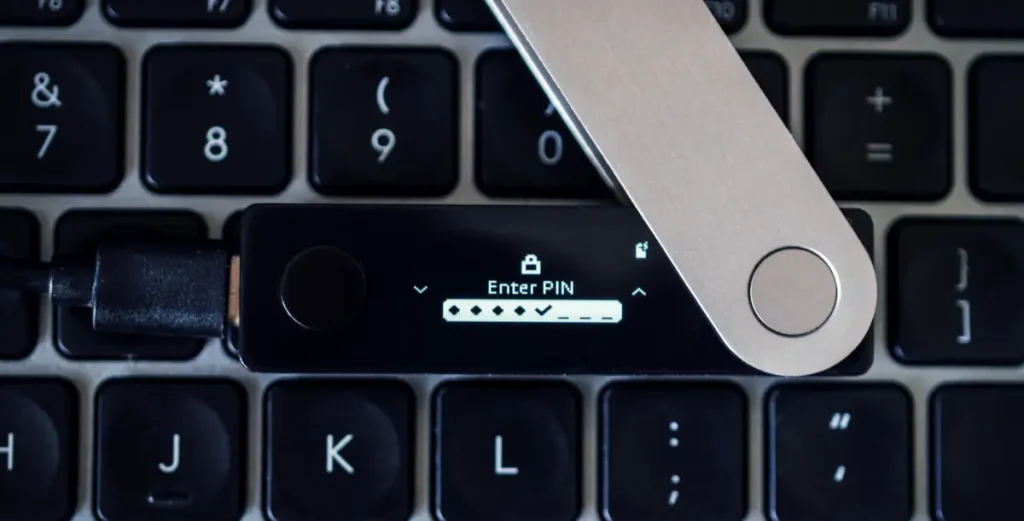
- Verification (The Device): The hardware wallet receives the data. Its screen displays the recipient address and the amount. This is a critical security step: the user must physically look at the device screen to verify the details match the invoice. This protects against malware that might swap addresses on the computer screen.
- Signing: Once the user presses the physical button on the device to confirm, the hardware wallet uses its internal private key to cryptographically sign the transaction data.
- Broadcast: The device sends the signed transaction back to the computer. The computer broadcasts it to the blockchain network.
At no point in this process did the private key leave the device. The computer only ever saw the signed result.
Common Hardware Wallet Types and Examples
While there are many wallets on the market, businesses typically gravitate toward devices with established track records and specific connectivity features.
| Device | Connection Type | Best For |
| Ledger Nano X | Bluetooth / USB-C | Mobile operations and broad asset support |
| Trezor Model T | USB-C | Open-source transparency and touchscreen interface |
| SafePal S1 | Air-gapped (QR Code) | strict isolation; device never physically connects to a computer |
| BitBox02 | USB-C | Minimalist security design and Swiss engineering |
Note: For enterprise use, the “best” wallet is often one that integrates well with multi-signature software (like Gnosis Safe) or institutional custody platforms.
Why Hardware Wallet Selection Matters for Businesses
Selecting the right hardware wallet is fundamentally different for a business than for a consumer. While an individual might prioritize a simple interface, a CFO or treasurer is managing corporate liability. The context of billions lost annually to crypto theft frames this decision, making enterprise-grade features non-negotiable. Businesses require robust auditability to track who signed a transaction and when.
Furthermore, as companies engage with Decentralized Finance (DeFi) and other complex smart contracts, the risk of “blind signing” becomes a major concern. This occurs when a user approves a transaction on a basic hardware wallet without being able to verify exactly what the contract does. Enterprise-grade devices address this with “clear signing” capabilities, providing transparent detail to mitigate this critical B2B risk.
With these security fundamentals in mind, it becomes clear why hardware wallets are not used in isolation within a company. They are integral components of broader operational workflows designed to protect corporate assets.
B2B Use Cases for Hardware Wallets
Hardware wallets are rarely used in isolation within a company. They are usually part of a broader workflow.
Treasury Cold Storage
Companies holding Bitcoin or Ethereum on their balance sheet as a reserve asset do not need to move those funds daily. These assets belong in deep cold storage. A hardware wallet (or a set of them) secures these funds, with the physical devices locked in safes and access restricted to C-suite executives or designated key holders.
Vendor and Contractor Payouts
For businesses paying international contractors in USDC or ETH, a hardware wallet adds a layer of “2FA” (Two-Factor Authentication) to the payroll process. Even if the payroll manager’s laptop is compromised, the hacker cannot drain the payroll wallet without physical access to the device to press the confirmation button.
Secure Fundraising Management
For businesses raising funds through token sales or other crypto-based fundraising methods, hardware wallets play a vital role in ensuring the security of raised assets. By isolating private keys and requiring physical confirmation for transactions, hardware wallets protect against unauthorized access during high-stakes fundraising events. This ensures that funds remain secure until they are allocated or distributed.
Hardware Wallets in Enterprise Wallet Architectures
Sophisticated enterprises view hardware wallets as one component of a larger “tech stack.”
The hardware wallet provides the key security. However, the workflow is managed by software layers. API orchestration layers can connect a hardware wallet to accounting software, ensuring that every transaction signed by the device is automatically logged for reconciliation.
Compliance teams also rely on this architecture. By integrating hardware wallets with enterprise wallet software, companies can enforce role-based controls (e.g., “Junior managers can draft transactions, but only the CFO’s hardware wallet can sign them”).
Implementation Best Practices for Enterprise Teams
Buying the device is the easy part. Implementing it securely requires rigorous policy design.
Key Management and Separation of Duties
Never allow a single person to generate the seed phrase, back it up, and hold the device. Split these responsibilities. If one person holds the device, another should hold the backup location access.
Seed Phrase Security
Treat the seed phrase as toxic waste—dangerous if mishandled. Do not print it on a networked printer (which has internal memory). Write it down by hand or stamp it into steel. Store backups in geographically distinct locations to protect against natural disasters.
Device Lifecycle Management
Hardware wallets should be tracked assets, just like company laptops. Log the serial numbers. Ensure firmware is updated regularly (but only after verifying the update is legitimate). When a device is retired, it must be wiped and physically destroyed.
Monitoring and Reconciliation
Set up “watch-only” wallets. These are software interfaces that track the balance and transaction history of your hardware wallet without holding the private keys. This allows accounting teams to monitor funds and reconcile ledgers without ever exposing the secure devices to risk.
Hardware Wallets as the Foundation of B2B Crypto Security
For any business entering the digital asset economy, the hardware wallet serves as the bedrock of trust. It transforms an intangible, high-risk asset into something that can be physically secured, providing a crucial line of defense against online threats. By isolating private keys from the internet, these devices form the core of a resilient security posture.
However, a hardware wallet alone is not a silver bullet. True enterprise-grade security emerges when these devices are integrated into a comprehensive framework that includes robust internal policies, clear separation of duties, and a culture of security awareness. The device is the starting point, but the system it operates within determines its ultimate effectiveness.
Building that system requires more than just off-the-shelf products; it demands a sophisticated wallet infrastructure designed for corporate governance and scalability. To learn how a tailored wallet infrastructure system can elevate your hardware security into a complete, enterprise-ready custody solution, explore the wallet infrastructure systems provided by ChainUp.