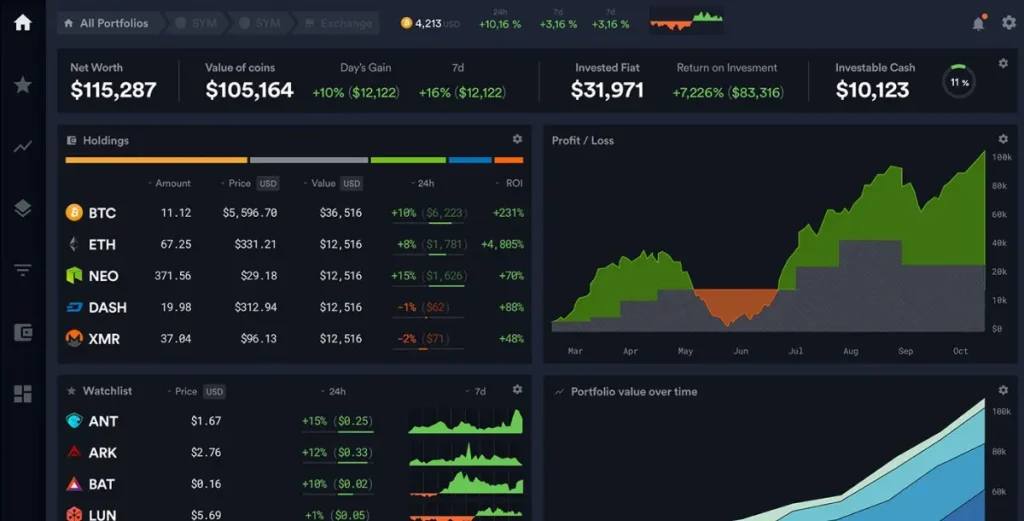
For modern asset managers, Chief Investment Officers (CIOs), and family offices, the days of tracking wealth on a simple spreadsheet are over. The explosion of digital assets, from cryptocurrencies and Decentralized Finance (DeFi) positions to Non-Fungible Tokens (NFTs), has created significant operational blind spots. Without a unified view, teams struggle with fragmented data, manual reconciliation, and a lack of real-time visibility, exposing firms to compliance and governance risks.
Finding the best crypto portfolio tracker is no longer about just monitoring Bitcoin’s price. It’s about implementing institutional-grade crypto wealth management tools that consolidate every asset class into a single source of truth. This guide breaks down the top five portfolio trackers for professional use in 2025, explaining how to select the right tools for your specific operational needs, from family office digital asset tracking to high-frequency DeFi analysis.
Why Net Worth Visibility Is Now a Governance Issue
Fragmented data is more than an inconvenience; it’s a critical governance failure. When assets are scattered across wallets, exchanges, DeFi protocols, traditional bank accounts, and private equity holdings, it becomes impossible to manage risk or make informed strategic decisions. This lack of a unified view creates operational chaos and obscures the true financial picture of an entity.
This fragmentation happens more often in crypto because the ecosystem is inherently decentralized. Assets are spread across multiple chains, platforms, and custodial models that do not follow a common reporting standard. In traditional finance, infrastructure is regulated, interoperable, and built around consolidated statements. Crypto systems operate in silos, so organizations quickly accumulate isolated data sources with no automatic way to reconcile them into a single, reliable view.
“Best” Means Multi-Asset and Multi-Chain
For an institutional crypto portfolio tracker to be effective, it must offer comprehensive visibility. This includes:
- On-Chain and DeFi Visibility: The tool must read data directly from blockchains to accurately track complex positions like staked assets, liquidity pool holdings, and lending/borrowing activities.
- Traditional Account Connectivity: Seamless integration with banks, brokerage accounts, and other TradFi systems is essential for a complete net worth overview.
- Support for Multi-Entity Structures: Family offices and large enterprises often manage wealth across multiple trusts, special purpose vehicles (SPVs), and individual family members. The right software must accommodate these complex ownership structures.
The Rise of the Dual-Dashboard Model
To solve this fragmentation, professional teams are increasingly adopting a dual-dashboard approach. This model separates high-level strategic oversight from granular, day-to-day operational monitoring. One dashboard provides the CIO or principal with a consolidated net worth view, while another gives analysts the deep on-chain data they need to manage positions effectively.
The 5 Best Crypto Portfolio Trackers for Professional Use in 2025
1. CoinStats — Best for Crypto-First Operational Monitoring
CoinStats excels at providing a detailed, crypto-centric view of assets spread across multiple exchanges and wallets. Its strength lies in its comprehensive DeFi and NFT visibility, making it an ideal operational tool for analysts who need to track on-chain performance with precision. For example, a portfolio manager can use CoinStats to monitor staked Ethereum (ETH) returns, Centralized Finance (CeFi) exchange holdings, and the floor price of their NFT collection simultaneously.
Best for: Crypto-heavy portfolios requiring accurate, on-chain profit and loss (P&L) calculations.
2. Kubera — Best Institutional-Grade Net Worth Aggregator
Kubera is designed for the high-level, strategic overview needed by CIOs and family office principals. It goes far beyond crypto, connecting to banks, brokerages, real estate data, and even allowing manual entry for private assets and collectibles. Its ability to support multi-entity structures makes it one of the most powerful multi-asset portfolio tracking software solutions available for consolidating a complete net worth picture across traditional, crypto, and real-world asset (RWA) portfolios.
Best for: CIOs and family offices needing an executive-level dashboard that consolidates total net worth.
3. Delta — Best Mobile Multi-Asset Tracker for Cross-Market Traders
Delta offers a fast, clean interface perfect for teams that actively trade both equities and digital assets. Its real-time alerts and slick mobile experience empower portfolio managers to monitor positions on the go. Imagine tracking your firm’s allocations in Solana (SOL), Nvidia (NVDA), and a new Bitcoin Exchange-Traded Fund (ETF), all from a single, intuitive dashboard. While it’s less focused on deep DeFi analytics, its cross-market capabilities are unmatched for traders.
Best for: Trading teams requiring instant, multi-asset insights without a heavy focus on complex DeFi strategies.
4. Zerion — Best Web3-Native Tracker for On-Chain Strategies
For professional DeFi desks, Zerion is the gold standard. It provides deep multi-chain analytics specifically for complex Web3 positions, delivering accurate data on liquidity pools, yield farming, and lending protocols. An analyst can use Zerion to precisely track the performance of positions in Aave and Uniswap V3 across multiple chains like Ethereum and Polygon, a task that is nearly impossible with less specialized tools.
Best for: Professional DeFi desks and analysts managing complex, multi-chain Web3 strategies.
5. CoinMarketCap Portfolio — Best Free Onboarding Tool
While not an institutional-grade solution, the CoinMarketCap Portfolio tracker is an excellent entry point. It relies on simple, manual tracking, making it a great, low-risk tool for interns, assistants, or early-stage crypto teams learning the ropes. It helps establish basic tracking habits before the organization is ready to invest in more sophisticated, full-stack Web3-to-TradFi reporting tools.
Best for: Low-risk environments and teams not yet ready for automated, full-stack solutions.
How Professional Teams Combine Trackers for Full Visibility
No single tool solves every problem. The most effective firms build a robust stack of trackers to achieve complete net worth visibility.
Step 1: Map the Entire Asset Universe
First, identify and categorize all assets under management.
- Crypto: Wallets, centralized exchanges, DeFi protocols, NFTs.
- Traditional: Bank accounts, brokerage holdings, real estate, private equity.
- Other: Tokenized RWAs, collectibles, and other alternative investments.
Step 2: Adopt the Dual-Dashboard Model
Implement a two-tiered system for portfolio management:
- Primary Strategic Dashboard: Use a tool like Kubera to consolidate the total net worth across all entities and asset classes for high-level reporting.
- Secondary Operational Dashboard: Employ a specialized tool like Zerion or CoinStats for daily on-chain intelligence and granular position management.
Step 3: Follow Operational Best Practices
- Standardize Tags: Create a consistent tagging system for all assets (e.g., core holdings, yield-generating, alternatives) to ensure clean reporting.
- Maintain Audit Trails: Use monthly CSV exports to create a reliable audit trail for compliance and tax purposes.
- Enforce Security: Always use read-only API keys to connect trackers to exchanges and wallets, minimizing security risks.
- Establish a Review Cadence: Implement a schedule for portfolio reviews—weekly for operational dashboards and monthly for the consolidated strategic view.
Scenario-Based Recommendations for B2B Teams
Different B2B teams require different tracking stacks depending on their asset mix and operational maturity.
Crypto-native asset managers usually need the deepest on-chain intelligence, so Zerion for DeFi analytics, CoinStats for broad multi-wallet monitoring, and Kubera for consolidated wealth reporting together give them full coverage. Multi-asset trading desks operate across markets, making Delta the central trading and analytics hub, while CoinStats covers the crypto-specific gaps and Kubera provides high-level institutional visibility.
Family offices prioritize total net worth oversight, so Kubera becomes the primary dashboard, with Zerion added for on-chain exposure and CoinStats for reconciliation and data exports. Early-stage crypto teams can start simple with the CoinMarketCap Portfolio, then upgrade to Zerion or CoinStats as their asset mix and operational needs grow.
Why Clean Portfolio Data Is a Pillar of Governance
In an era of increasing regulatory scrutiny, clean, consolidated portfolio data is non-negotiable. The rise of tokenized assets (RWAs) further blurs the line between TradFi and digital assets, making unified visibility essential. Accurate, real-time data improves tax readiness, streamlines financial reporting across different legal entities, and reduces operational risk by giving decision-makers the transparent insights they need to act confidently.
Modern Operations Demand Modern Tools
Achieving total net worth visibility is no longer an aspirational goal—it is a fundamental requirement for sound governance and strategic decision-making. As the digital asset landscape matures, the line between consumer-grade gadgets and enterprise-grade infrastructure has become sharply defined. The firms that thrive will be those that invest in a robust, multi-layered approach to portfolio tracking, ensuring every asset is accounted for.
For firms demanding this level of rigor, the foundational layer is non-negotiable: institutional-grade security and compliance. This is where operational intelligence meets security. When evaluating your digital asset infrastructure, look for partners built on ChainUp’s secure multi-party computation (MPC) based wallet infrastructure, multi-chain custody frameworks, and regulatory-ready systems. Infrastructure providers like ChainUp deliver the secure foundation that transforms fragmented holdings into a controlled, auditable, and governable operation, ready for regulatory scrutiny.