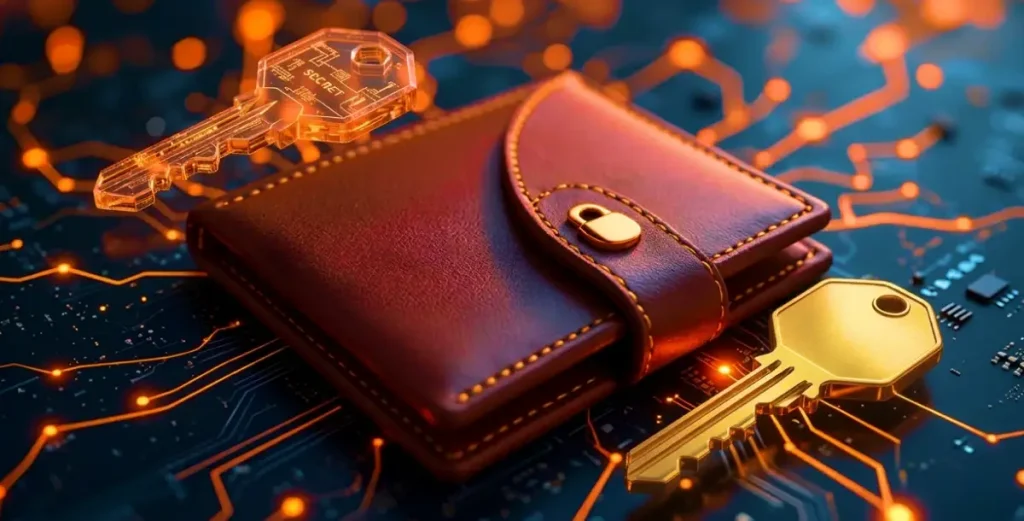

Your public key (and its shortened form, the address) is safe to share and tells others where to send funds. Your private key proves you own those funds and lets you sign transactions. Wallets don’t hold coins—they hold keys; assets live on the blockchain. Lose the private key (or seed phrase), and you lose access. Share it, and anyone can spend your assets.
Here’s clear, concise, and SEO-optimized content for your headers, plus a comparison table that highlights the key differences between private and public keys:
What is a Private Key?
A private key is a secret cryptographic code that proves ownership of a cryptocurrency wallet. It allows the holder to sign transactions and access the funds stored in the wallet.
Think of it as your digital password or signature—it must be kept completely confidential. If someone else obtains your private key, they can control your crypto assets. Private keys are typically stored in hardware wallets, encrypted software wallets, or secure offline environments.
What is a Public Key?
A public key is a cryptographic code derived from your private key. It acts as a receiving address where others can send you crypto. While it’s mathematically linked to your private key, it cannot be used to access or move your funds.
Public keys (or their hashed versions) are safe to share, and they’re what most wallet addresses are based on. They allow the blockchain to verify your signature and ensure that transactions are valid.
Public Key vs Private Key: What’s the Difference?
| Feature | Public Key | Private Key |
| Purpose | Used to receive crypto and verify signatures | Used to sign transactions and access funds |
| Visibility | Can be shared publicly | Must be kept secret |
| Access | Cannot control funds | Grants full control over associated wallet |
| Generated From | Derived from the private key | Randomly generated first, then used to derive public key |
| Storage | Typically stored in wallets or shown as wallet address | Must be securely stored in encrypted or cold storage |
| Security Risk | Low—no risk in sharing | High—loss or exposure can lead to asset theft |
What Is a Key Pair?
Cryptocurrencies use asymmetric cryptography: a randomly generated private key and a mathematically linked public key. From the public key, networks derive a shorter address that users share to receive funds.
Only the matching private key can authorize spending by producing a digital signature that nodes can verify with the public key—no secrets revealed.
On Ethereum, for example, your address is the last 20 bytes of the Keccak-256 hash of the public key, prefixed with 0x.
In short, your address is the mailbox location; the private key is the only key that opens it.
How Signatures Prove Ownership
When you “send crypto,” your crypto wallet:
- Builds a transaction (recipient, amount, fee).
- Signs its hash with your private key (ECDSA/EdDSA, depending on the chain).
- Broadcasts the signed transaction.
- Nodes verify the signature with your public key, then miners/validators include it in a block.
The math guarantees only the private key holder could have created that signature, while the private key itself stays hidden. Bitcoin and Ethereum developer references detail how nodes verify and how transactions are structured.
Wallets Don’t Hold Coins, They Hold Keys
Your coins live on the blockchain. A wallet—software or hardware—stores keys securely, derives your addresses, shows balances by reading the chain, and signs transactions on request. Types include:
- Software wallets (mobile/desktop/browser): convenient; best for everyday amounts.
- Hardware wallets: isolate keys in a secure chip and sign transactions offline—ideal for larger holdings.
- Custodial wallets (exchanges): the platform holds keys for you; you gain convenience and recovery options but take on platform risk.
Seed Phrases & HD Wallets (BIP39/BIP32)
Modern wallets generate a 12–24 word seed phrase (mnemonic). That single seed deterministically creates many accounts/addresses (HD = hierarchical deterministic), so one offline backup can restore the entire wallet tree across compatible apps.
This is specified by BIP39 (mnemonics) and BIP32 (hierarchical keys). An optional passphrase (“25th word”) strengthens security; you must store seed and passphrase together to recover.
Best practice is to write the seed offline (paper or steel), store in two safe places, and test a restore before moving serious funds.
Bitcoin vs. Ethereum (and Others): Key Details You’ll Notice
- Bitcoin-style (UTXO) addresses are derived from public keys using specific formats (e.g., bech32), and wallets manage many addresses under one seed.
- Ethereum addresses come from the public key as noted earlier; the most common signature scheme is ECDSA over secp256k1.
- Some networks (e.g., Solana, Cosmos/Tendermint components) use Ed25519 signatures instead of ECDSA.
Multisig, MPC, and Smart-Contract Wallets: Safer Ways to Hold Keys
You can upgrade beyond a single private key:
- Multisig (m-of-n): spending requires multiple keys (e.g., 2-of-3). Great for families, teams, and treasuries. (Bitcoin and EVM chains both support multisig patterns.)
- MPC wallets (threshold signatures): one logical key is split into shares across devices/services; no single place ever holds the full key, improving resilience against loss/compromise (vendor-neutral concept across many chains).
- Smart-contract / Account-Abstraction wallets (ERC-4337): your “account” is a contract with programmable rules—social recovery, spending limits, session keys, batched transactions, and gas abstraction—enabled on Ethereum via EIP-4337.
Privacy and Address Hygiene
Addresses are pseudonymous, not private. Reusing addresses can leak information. Good hygiene includes generating fresh receive addresses (especially on UTXO chains), verifying the full address when pasting, and using human-readable names (e.g., ENS) or QR codes to reduce errors. Advanced users explore stealth addresses to separate public identity from receive addresses.
Common Mistakes and How to Avoid Them
Crypto is unforgiving: keys are final, transactions are irreversible, and “support” can’t reset a seed phrase. Most losses come from simple slips—unsafe backups, phishing, copy-paste errors, and single-device failures.
Treat your wallet like a safety-critical system: create offline backups, verify addresses end-to-end, and remove single points of failure before you move real value. With that mindset, the fixes below are straightforward habits rather than tech tricks.
- Storing the seed digitally: photos, cloud notes, email. Fix: keep it offline; consider steel backups.
- No recovery test: a seed you can’t restore is as risky as no seed. Fix: do a dry-run restore on a spare device.
- Phishing & fake support: no legitimate service will ever ask for your seed/private key. Fix: verify URLs; never share secrets.
- Single point of failure: one device, one backup. Fix: use hardware wallets and consider multisig/MPC for larger balances.
- Copy-paste traps (address poisoning): look-alike addresses in history. Fix: verify full addresses; use QR/ENS when possible.
- IP39/BIP32. Mnemonic seeds and hierarchical deterministic wallets.
- Bitcoin developer docs. Transactions, validation, and wallet concepts.
- Account Abstraction (ERC/EIP-4337). Smart-contract wallets with social recovery and gas abstraction.
- Ed25519 in other ecosystems. Signature schemes beyond secp256k1.
Conclusion
Mastering keys means mastering ownership. Share addresses to receive, guard private keys and seed phrases, and upgrade your setup over time—hardware wallets for savings, plus multisig or MPC for larger balances.
Treat backups like mission-critical data, verify every transaction end-to-end, and you’ll avoid 99% of preventable losses.
If you’re building for users—an exchange, wallet, or payments app—ChainUp can help you ship secure key management from day one. Its modular stack (custody, MPC/multisig workflows, compliance, and wallet SDKs) lets you focus on product while meeting security and regulatory needs. Explore ChainUp’s solutions to accelerate launch and scale with confidence.
Frequently Asked Questions
Can someone derive my private key from my public key?
No. The cryptographic algorithms used (e.g., elliptic curve cryptography) make it computationally impractical to derive a private key from a public key. That’s what makes the system secure.
Do I need both keys to send crypto?
You only need the private key to sign and send a transaction. The public key is used by others (or nodes) to verify that your transaction is valid. They don’t need your private key.
What happens if I lose my private key?
You lose access to your funds permanently. There is no “reset” or “forgot password” for private keys. That’s why backup and secure storage (e.g., hardware wallets, seed phrases) are essential.
Why do some wallets show addresses instead of public keys?
Wallet addresses are often derived from the public key by applying one or more hashing steps or encoding formats (e.g. Base58Check). This creates a shorter, network-compatible address while preserving the cryptographic link to your public key.
Are private keys stored by exchanges or wallets?
In custodial wallets or exchanges, the platform may manage private keys on behalf of users (not always ideal from a trust perspective). In non-custodial wallets, you hold the private key yourself and the platform never sees it.